
S2000 Rotrex + Electric Motor

SteveB

New member
Hi everyone. My design is mostly finished and built. It has a FreeRcHobby motor driving a C30 Rotrex, VESC speed controller, InterCooler and a 32S LTO battery. I've done quite a bit of bench testing and it looks like I may be able to get +100HP for my S2000 (240 to 340). I have a youtube channel - Steve Brantley "Supercharger In a Box."
I'm struggling some now with the VESC speed controller talking to an Arduino over a CAN bus. It works, but for some reason drops out and quits responding to commands at times. Very frustrating.

This is a 100% street car, so got to carefully manage temps, etc. I also want it to feel like a NA car driving, so motor control is challenging.

Any advice is very welcome!

Thanks
Steve
 

Attachments

  • Blower.jpg
    Blower.jpg
    741.6 KB · Views: 4
Hi everyone. My design is mostly finished and built. It has a FreeRcHobby motor driving a C30 Rotrex, VESC speed controller, InterCooler and a 32S LTO battery. I've done quite a bit of bench testing and it looks like I may be able to get +100HP for my S2000 (240 to 340). I have a youtube channel - Steve Brantley "Supercharger In a Box."
I'm struggling some now with the VESC speed controller talking to an Arduino over a CAN bus. It works, but for some reason drops out and quits responding to commands at times. Very frustrating.

This is a 100% street car, so got to carefully manage temps, etc. I also want it to feel like a NA car driving, so motor control is challenging.

Any advice is very welcome!

Thanks
Steve
Outstanding accomplishment, I don't know what to tell you about the VESC other than to replace it with something else. I have a 16S VESC and still have not figured out why it would cutout short of max power during bench testing. There is one more setting change to try in an effort to solve the issue but from what I've read so far in the area of management problems in general, I've already solved the problem by going with a traditional ESC minus all of the "Extra" and will try to sell the VESC to get some of my cash back as it is too unreliable to continue with for this application.

I'm onboard with the minimal modifications to a stock car and coming from many traditional turbo builds also want to keep it very simple, although CANBUS integration is interesting, my plan is to use a micro controller programmed to send a load signal to the ESC, based on voltage input from the appropriate sources; throttle position, pedal position, rpm and a stand alone 2 bar MAP.

I'm using hybrid batteries from GM vehicles at the 16s level which I believe are a great resource.

I considered the rising rate fuel pressure regulator early on but understand my stock system is capable of supporting about 12 psi with programming. Instead I'll be adding a water methanol injection kit for the benefit of added fuel and outstanding knock suppression plus cooler intake charge. It's really good stuff. It has a way of smoothing out the pulses in the combustion process that can literally be felt in the seat as a sensation of reduced vibrations.
 
I've set up my system to kick in at a throttle position where the engine makes it's max NA power (this is way less than 100% open). I found that doing so any earlier just wastes electrical energy and runs you out of juice too soon. Hope that helps.
Also: just watched your you tube video .... my setup is similar but a lot less complex. Everything works well and it makes good power on a street car. Might be worth you checking out my thread : https://www.electrifiedboost.com/threads/rx8-renesis-rotary-esc.220/
 
Last edited:
Thanks for the input fellas. The VESC is my first experience with speed controllers. I have spent an enormous amount of time getting it behaving correctly. I think I figured out the latest issue. It was apparently shutting down due to inactivity, but the Status Light on the front panel was staying lit saying it was not shut down?? I extended the shut down time and the problem went away - typical VESC: try shit until it seems to work. I'm crossing my fingers.
 
I've set up my system to kick in at a throttle position where the engine makes it's max NA power (this is way less than 100% open). I found that doing so any earlier just wastes electrical energy and runs you out of juice too soon. Hope that helps.
Also: just watched your you tube video .... my setup is similar but a lot less complex. Everything works well and it makes good power on a street car. Might be worth you checking out my thread : https://www.electrifiedboost.com/threads/rx8-renesis-rotary-esc.220/
Hadn't quite appreciated the importance of this fact until after a second look. Running the motor outside of its peak efficiency range would indeed waste electrical energy.

Having given more thought to the matter, perhaps full motor power and pulse width modulated (PWM) wastegate (blow off valve) control to bleed air pressure off to maintain a specific boost level for a given rpm would be better.

I believe that not only would it allow for faster spool-up due to no back pressure load on the compressor wheel as it's initially climbing onto the map, you could probably time the boost onset better, not to mention create a boost onset parameter near the equivalent of dumping a clutch at onset, keeping in mind rpm range must be appropriate to avoid damaging the motor.
 
Last edited:
I ended up driving the ESC from the arduino by comanding Duty Cycle. That way the motor spools up at max motor current, then levels off when the commanded DC is reached.
 
Last edited:
Got everything installed. First test drive went well. I have the boost turned way down, but it is still making boost all the way to redline. I'll provide more details soon.
 

Attachments

  • 20251211_103152.jpg
    20251211_103152.jpg
    520.3 KB · Views: 11
  • 20251211_103216.jpg
    20251211_103216.jpg
    436.2 KB · Views: 11
I had a week of fighting the ecu. It was pulling a ton of timing killing all power. I got that sorted - I had clamped the MAP sensor a little too high and the ecu was unhappy. I'm surprised it didn't throw a code, so it took a while to find it. Also, my rising rate fuel regulator (FMU) quit working so I'm limited to only 2psi of boost until that is sorted. Below is a copy of a post I did on the S2k forum:

My early impressions of an electric blower on a street s2000 are all positive so far: 1) I was worried about how it may sound, as unlike an engine driven centrifugal, this one runs at pretty much constant speed as engine rpm rises. I had to have ear protection when I was bench testing it. But in the car I could barely hear it. Intake and exhaust noise completely dominate blower noise at 2psi. 2) For only 2psi, the car feels stronger than I expected. The mid range pull through VTEC feels really good. The engine doesn't drive the blower, so there is some extra crankshaft power. 3) unlike a normal supercharger, this one is not turning until needed, so it takes a little time to spool. I didn't feel or hear the blower turning on, it was very normal. With more boost, it may be more noticeable. The turn-on can be tuned in software. 3) I drove around for about 20 minutes and did maybe 20 pulls of 2 or 3 seconds each. Typically in 3rd gear from 4500 to 7500 rpm or so. The 84V battery voltage didn't move at all. The charger runs all the time and kept up with the power drain from the small pulls. The battery can run down to as low as about 74V. 4) I saw about -2psi of boost at high rpm's with the blower off. I'm thinking this is probably ok and I won't need a bypass valve. There will hopefully be enough battery capacity so that running without boost will be rare, and -2 psi should be ok occasionally. 5) IAT barely moved during boost although its only 2psi. My gauge runs on its own sensor before the TB that shouldn't heat soak as bad as the stock one.
 
I had a week of fighting the ecu. It was pulling a ton of timing killing all power. I got that sorted - I had clamped the MAP sensor a little too high and the ecu was unhappy. I'm surprised it didn't throw a code, so it took a while to find it. Also, my rising rate fuel regulator (FMU) quit working so I'm limited to only 2psi of boost until that is sorted. Below is a copy of a post I did on the S2k forum:

My early impressions of an electric blower on a street s2000 are all positive so far: 1) I was worried about how it may sound, as unlike an engine driven centrifugal, this one runs at pretty much constant speed as engine rpm rises. I had to have ear protection when I was bench testing it. But in the car I could barely hear it. Intake and exhaust noise completely dominate blower noise at 2psi. 2) For only 2psi, the car feels stronger than I expected. The mid range pull through VTEC feels really good. The engine doesn't drive the blower, so there is some extra crankshaft power. 3) unlike a normal supercharger, this one is not turning until needed, so it takes a little time to spool. I didn't feel or hear the blower turning on, it was very normal. With more boost, it may be more noticeable. The turn-on can be tuned in software. 3) I drove around for about 20 minutes and did maybe 20 pulls of 2 or 3 seconds each. Typically in 3rd gear from 4500 to 7500 rpm or so. The 84V battery voltage didn't move at all. The charger runs all the time and kept up with the power drain from the small pulls. The battery can run down to as low as about 74V. 4) I saw about -2psi of boost at high rpm's with the blower off. I'm thinking this is probably ok and I won't need a bypass valve. There will hopefully be enough battery capacity so that running without boost will be rare, and -2 psi should be ok occasionally. 5) IAT barely moved during boost although its only 2psi. My gauge runs on its own sensor before the TB that shouldn't heat soak as bad as the stock one.
I believe a series of low to medium flow water/methanol injection nozzles might be a better option over the mechanical rising rate fuel delivery unless you can make it more dependable. You probably will not suffer much of an issue at such a low boost pressure when it fails to show up for duty such as in this case. Back when boost was still very new in the 80s I believe paxton used a series of extra injectors that were activated sequentially for additional fuel flow. Pressure activated solenoids are available to keep it fairly simple pressure activated directly or indirectly through a programmable controller. -2 psi of vacuum up top, I would want to fix that. Nice work.
 
IMO you need to get tuning software and tune it for boost. Trying to do it mickey mouse style might be ok for 1-2psi but it will severely limit the potential of your system once you start raising the boost.
 
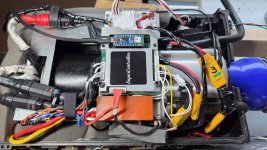
The motor coupling bolts to the blower input and clamps to the motor shaft. The all-thread rods align the coupling, then the aluminum box screws are tightened up which holds it all solid. I think the motor is putting out about 14hp at 6500rpm. You can see one of the cooling fans at the far right. This one sucks air through the center of the motor (stator).


coupling.jpg
 
IMO you need to get tuning software and tune it for boost. Trying to do it mickey mouse style might be ok for 1-2psi but it will severely limit the potential of your system once you start raising the boost.
Unfortunately, the ECU on the early S2000 cannot be tuned. I'd have to replace it to tune it. I turned the boost up to 4psi today and drove for a while. 4psi totally transforms the way the car drives. I'm thinking I may limit the boost at 3 - 4 psi and use the FMU for a while, but it needs tweaking. My wideband is saying I'm around 12.5 to 13.5, which is a little higher than I'd like. This setup should be capable of 10psi below 5k rpm, dropping to around 6psi at 9000. The boost is limited by motor rpm below 5k, and motor power above that. If I go above 4psi, I'll probably replace the ecu and injectors, and get a tune. But I really planned for this to be a simple, drop in system thats easy to delete and return to stock. An ECU change kinda goes against that. There are a number of early s2000's running around with 6psi blowers with FMU's and MAP clamps, so that is what I'm trying to emulate.
 
Last edited:
Unfortunately, the ECU on the early S2000 cannot be tuned. I'd have to replace it to tune it. I turned the boost up to 4psi today and drove for a while. 4psi totally transforms the way the car drives. I'm thinking I may limit the boost at 3 - 4 psi and use the FMU for a while, but it needs tweaking. My wideband is saying I'm around 12.5 to 13.5, which is a little higher than I'd like. This setup should be capable of 10psi below 5k rpm, dropping to around 6psi at 9000. The boost is limited by motor rpm below 5k, and motor power above that. If I go above 4psi, I'll probably replace the ecu and injectors, and get a tune. But I really planned for this to be a simple, drop in system thats easy to delete and return to stock. An ECU change kinda goes against that. There are a number of early s2000's running around with 6psi blowers with FMU's and MAP clamps, so that is what I'm trying to emulate.
This is the reason for the creative fuel delivery, being minimally invasive with an otherwise stock car, maintaining the ability to quickly undo modifications. There's nothing wrong with secondary fueling methods as long as they can be made dependably safe and they can be. In my experience with tuning the stock computer, it is often very challenging to make fueling adjustments that meet the power adder requirements without sacrificing some element of drivability on a system not originally designed for boost, especially for those of us who do not have access to or want to spend the funds for hours of dyno time to dial it in.

That's how it was done in the early days of custom boost applications before the general public had access to a means to reprogram the fuel/timing map. Current existing vehicle drivetrain management is far more advanced and complicated than it was 20 yrs ago as today's torque based systems depend on all sorts of inputs and tables that preclude simplicity. An errant data input could get you in big trouble fast as one individual on a car forum explained where an attempt to adjust the complicated timing advance tables resulted in the throttle not closing when he released the accelerator pedal on a test drive. The spark tables had throttle response tied into them.
 
I'd like to avoid adding another fuel/liquid to store, replenish, rely on. I couldn't find room under the hood for extra water storage for the intercooler, and I'm trying to keep it close to a box stock s2000 for ease of everyday street use. What do you think about injecting gasoline instead, maybe like a wet nitrous system? My fuel rail is tapped for a fuel fitting (I ran nitrous for a while). The fuel is already pressurized - no additional pump needed.
 
I'm reading about adding an aux fuel injector into the charge pipe and controlling it with the existing Arduino. Can either replace the FMU or smooth out and augment its response. Obviously not as good as a new ECU, but maybe good enough for 6psi, especially if I add a fail safe to shut boost down for bad A/F. Any thoughts?
 
Top