
You are using an out of date browser. It may not display this or other websites correctly.
You should upgrade or use an alternative browser.
You should upgrade or use an alternative browser.
RX8 Renesis Rotary eSC
- Thread starter brettus8
- Start date


r.brown.bayliss
Member
Yes, it makes sense that the PSI would drop as RPMs rise. Unless the compressor is increasing speed as well, but then having as much boost as you can at any point is better than reducing it in the middle just to make the top look better.Put Bluey on the dyno today . Was hoping to break 300whp but didn't quite get there.
peak power of 282whp with impressive (for a rotary) midrange torque of 204lb/ft. Note to boost decline 6.5 down to 4psi at peak which was a little disappointing. Black trace on dyno was same car N/A so an increase of 73whp with only 4psi! Battery was outputting 360A @ 44v at peak power.
Nice to see it moving forward
I've often looked at this trend and imagined being able to achieve a max boost level that was too high from launch, to just over midrange rpm so that the excess could then be parsed in to sustain a long flat power peak as the excess boost became appropriate/safe to apply with the increasing and less efficient rpm region where boost would normally start to drop off, in an effort to give acceleration an infinite feeling of power.Yes, it makes sense that the PSI would drop as RPMs rise. Unless the compressor is increasing speed as well, but then having as much boost as you can at any point is better than reducing it in the middle just to make the top look better.
Nice to see it moving forward
I'm hoping the new outfit from Castle that Alex ordered will out perform the 2028 results that he recently demonstrated, if it does I'll be putting in my order. I thought the TP power 12Kw, 85k rpm motor geared down for torque multiplication while still able to maintain good relative compressor speeds would have been a more productive performer with the benefit of the torque multiplication added to its high rpm, but at $400 and approximately a month long wait compared to the Castle outfit, maybe not.
Here's a great video on a very doable car alternator mod that yielded 90 volts and a max current of 100 amps that I believe will inspire everyone intent on having an onboard battery charging system.
I just read through this whole thread and really like what I am seeing/reading. Thank you for sharing and thanks to all that replied.
I do have a question for Brettus8, what elevation are you at when doing this testing? I guess most specifically where you had the car on the dyno.
I do have a question for Brettus8, what elevation are you at when doing this testing? I guess most specifically where you had the car on the dyno.
Hamilton NZ which is at 40m above sea level.I just read through this whole thread and really like what I am seeing/reading. Thank you for sharing and thanks to all that replied.
I do have a question for Brettus8, what elevation are you at when doing this testing? I guess most specifically where you had the car on the dyno.
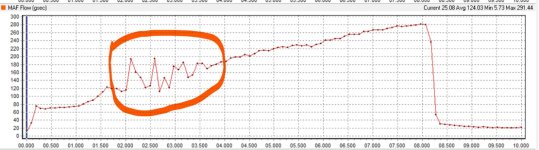
After fitting a larger drive wheel and upping the voltage I started getting the issue seen below. Wild MAF sensor swings and an odd noise from under the bonnet. Spent the last day trouble shooting. Tried retiming the ssv valve, changing the water injection amount etc etc and was running out of ideas. But while contemplating my navel this afternoon it hit me! Compressor SURGE! This is what it does to mass airflow at low rpms. Raised the ESC turn on by 500 rpms and .......... all gone.
Last edited:
Great problem display and accompanying solution for anyone who observes similar data in their build.After fitting a larger drive wheel and upping the voltage I started getting the issue seen below. Wild MAF sensor swings and an odd noise from under the bonnet. Spent the last two days trouble shooting. Tried retiming the ssv valve, changing the water injection amount etc etc and was running out of ideas. But while contemplating my navel this afternoon it hit me! Compressor SURGE! This is what it does to mass airflow at low rpms. Raised the ESC turn on by 500 rpms and .......... all gone.
View attachment 904
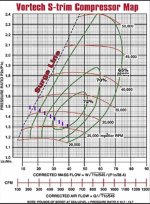
Thanks .... the mass airflow numbers actually line up perfectly with the compressor Flow map Alex recently updated too! Renesis flow in purple from 3500rpm to 8500Great problem display and accompanying solution for anyone who observes similar data in their build.
Also : I think I found the limiting values for the hobywing max 4 ESC . It trips out when over 300A for more than 4.5s (approx). Doesn't seem to matter how far over 300A you go........
Last edited:
Update :
Having to bring the eSC in quite late due to surge as mentioned above was getting to me.
Had been thinking about variable speed control but the idea of tuning an Aduino or similar doesn't appeal due to my lack of computer skills. So, I had a spare speed control board (they sent me an extra one by mistake) and decided to set up a two stage speed control using two boards an extra relay and another microswitch on the throttle pedal.
Have put all that into place and now have a two speed setup. First stage runs at approx. half speed and kicks in at any rpm (no surge) at about 1/2 throttle. Second stage kicks in at around 4000rpms when foot is flat to the floor.
This works fantastic ...love it! The setup is now way more practical both around town and out on the open road. It also means that the eSC is utilised way more for just light acceleration, giving the engine that extra punch without being OTT.
Finally got around to fitting a sensor cable. Was hoping that by it would improve efficiency of the motor at high rpms. Tested with and without the cable measuring eSC current and power of the engine (with virtual dyno). I believe there is an improvement! Motor current dropped by 30A (420 down to 390) without any perceived loss in engine power. Am hoping this will enable me to run a slightly larger drive pulley (26 vs 25T) without constantly tripping the ESC current limiter on extended pulls. Yet to fully test that theory.
Edit : It didn't ...... had to go back to the 25T pulley.
Having to bring the eSC in quite late due to surge as mentioned above was getting to me.
Had been thinking about variable speed control but the idea of tuning an Aduino or similar doesn't appeal due to my lack of computer skills. So, I had a spare speed control board (they sent me an extra one by mistake) and decided to set up a two stage speed control using two boards an extra relay and another microswitch on the throttle pedal.
Have put all that into place and now have a two speed setup. First stage runs at approx. half speed and kicks in at any rpm (no surge) at about 1/2 throttle. Second stage kicks in at around 4000rpms when foot is flat to the floor.
This works fantastic ...love it! The setup is now way more practical both around town and out on the open road. It also means that the eSC is utilised way more for just light acceleration, giving the engine that extra punch without being OTT.
Finally got around to fitting a sensor cable. Was hoping that by it would improve efficiency of the motor at high rpms. Tested with and without the cable measuring eSC current and power of the engine (with virtual dyno). I believe there is an improvement! Motor current dropped by 30A (420 down to 390) without any perceived loss in engine power. Am hoping this will enable me to run a slightly larger drive pulley (26 vs 25T) without constantly tripping the ESC current limiter on extended pulls. Yet to fully test that theory.
Edit : It didn't ...... had to go back to the 25T pulley.
Last edited:

I decided to switch to gearing after not being comfortable with the too hot to touch belt in my first build during unloaded short test runs and knew the temps would only get higher with actual boost pressure being generated and increased run times. I know these belts are capable in automotive applications in 1" widths (mine was .5), but that claim in what you posted above needs to add the specifics. The shorter the belt the greater the heat load on it as well as the shorter the pulley radius and narrower the width.
The belt failure that Alex had during testing with the unlimited ESC proved my decision to be a good one so far. I'm trying to avoid all headaches in the process.
I decided to switch to gearing after not being comfortable with the too hot to touch belt in my first build during unloaded short test runs and knew the temps would only get higher with actual boost pressure being generated and increased run times. I know these belts are capable in automotive applications in 1" widths (mine was .5), but that claim in what you posted above needs to add the specifics. The shorter the belt the greater the heat load on it as well as the shorter the pulley radius and narrower the width.
The belt failure that Alex had during testing with the unlimited ESC proved my decision to be a good one so far. I'm trying to avoid all headaches in the process.
Thanks for the reply. Interestingly, I'm not seeing my belt get hot at all at around 18KW peak and 27000rpm. Could be a few factors in play .... The water cooled compressor housing is also cooling the shaft/drive pulley, plus, I've got quite a conservative 'punch' setting on the ESC.
If you're running the 25 mm wide belt that would help and perhaps the pulley I was running was on the small side causing more flex related friction. Whatever the case it was too hot to be compatible with longevity. Another thing I just realized is that I was using belts with rounded cogs instead of true timing belt cogs which I'm sure have some +/- effect.Thanks for the reply. Interestingly, I'm not seeing my belt get hot at all at around 18KW peak and 27000rpm. Could be a few factors in play .... The water cooled compressor housing is also cooling the shaft/drive pulley, plus, I've got quite a conservative 'punch' setting on the ESC.
r.brown.bayliss
Member
I logged in today to aske how people were getting on with belts. I saw a reference to the T5 belts not being a good idea above 10,000rpm as well. MY intention is to use two Hobbywing 70125s to drive a common shaft at some were between 1.25x to 2x the motor rpm. and then use a belt from that to the P2's built in T5 pulley at a 1:1 ratio from the over driven shaft. My choice now is between a flat belt and the HDT belts. And that will be determined on what I can get that is short enough to fit in a confined space.
Or maybe, one T5 belt and some idlers, the belt going around both motors and the idlers into the P2? That certainly seems less complex on paper than 3 separate belts and a second shaft and bearings... Dilemmas
But what experience have others had with T5 at 25 to 25 thousand rpm?
Or maybe, one T5 belt and some idlers, the belt going around both motors and the idlers into the P2? That certainly seems less complex on paper than 3 separate belts and a second shaft and bearings... Dilemmas
But what experience have others had with T5 at 25 to 25 thousand rpm?
Had zero issues with mine .... highest power I've seen out of battery is 18.5Kw so far at 25000ish rpm - I think there is more left in it.But what experience have others had with T5 at 25 to 25 thousand rpm?
r.brown.bayliss
Member
I am finding it hard to get proper information. Every thing says T5 is for slow things like printers and other small machines, but I have also seen 60m per second max belt speed which is fast enough I think. Also saw an optibelt PDF that said 23kw in their technical manual, but not specific to a belt type and they make many different types.Had zero issues with mine .... highest power I've seen out of battery is 18.5Kw so far at 25000ish rpm - I think there is more left in it.
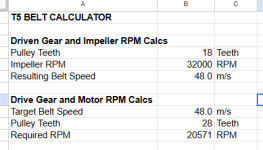
I have a spread sheet that calculates the belt speed based on pulley size and rpm, and then using that data I input the drive gear tooth count to get the motor RPM needed. 48ms seems far enough below 60ms to be safe. And my motors theoretical max is 25,000 RPM at 44 volts.
Just came back from 'Mad Mike's Summerbash'.
Had three one hour sessions on track . These sessions are not full blown race pace. Generally it's more about just cruising around the track until you reach a certain part of the track where it becomes a full on roll race for all and sundry. This is perfect for the eSC system as you get a full lap to recharge before each few seconds of mayhem.
Bluey went great for the whole day. Roll raced all manner of performance car and was pleasantly surprised at how competitive she was. Definately well into in the top 1/3rd of the cars there.
Was a hottish day at 27C. During the course of the session the steady state battery voltage dropped down by 4v at most and performance was not noticeably affected. Electric motor was getting too hot to touch and charger was getting hot as well. Batteries and BMS temps stayed below 45C all day. If I go for more power I'm going have to address the motor temp. The Max4 ESC does have a motor heat protection setting but I'm not sure what it is or if it's even turned on. If it was, it didn't trip out all day.
Had three one hour sessions on track . These sessions are not full blown race pace. Generally it's more about just cruising around the track until you reach a certain part of the track where it becomes a full on roll race for all and sundry. This is perfect for the eSC system as you get a full lap to recharge before each few seconds of mayhem.
Bluey went great for the whole day. Roll raced all manner of performance car and was pleasantly surprised at how competitive she was. Definately well into in the top 1/3rd of the cars there.
Was a hottish day at 27C. During the course of the session the steady state battery voltage dropped down by 4v at most and performance was not noticeably affected. Electric motor was getting too hot to touch and charger was getting hot as well. Batteries and BMS temps stayed below 45C all day. If I go for more power I'm going have to address the motor temp. The Max4 ESC does have a motor heat protection setting but I'm not sure what it is or if it's even turned on. If it was, it didn't trip out all day.
Last edited:
r.brown.bayliss
Member
Fans maybe?
Perhaps a water cooling jacket or other motor cooling support given some of the heat soak is most certainly contributed to by the hot engine bay.Just came back from 'Mad Mike's Summerbash'.
Had three one hour sessions on track . These sessions are not full blown race pace. Generally it's more about just cruising around the track until you reach a certain part of the track where it becomes a full on roll race for all and sundry. This is perfect for the eSC system as you get a full lap to recharge before each few seconds of mayhem.
Bluey went great for the whole day. Roll raced all manner of performance car and was pleasantly surprised at how competitive she was. Definately well into in the top 1/3rd of the cars there.
Was a hottish day at 27C. During the course of the session the steady state battery voltage dropped down by 4v at most and performance was not noticeably affected. Electric motor was getting too hot to touch and charger was getting hot as well. Batteries and BMS temps stayed below 45C all day. If I go for more power I'm going have to address the motor temp. The Max4 ESC does have a motor heat protection setting but I'm not sure what it is or if it's even turned on. If it was, it didn't trip out all day.