Your "bottom line" statement is correct; but your thinking about the Audi/Mercedes systems isn't.
The Audi setup is literally just a small electric supercharger. It literally has nothing to do with the conventional turbos - it's just there to "fill in the gap" until the conventional turbos spool up. Read this:
https://www.greencarcongress.com/2019/04/20190411-audi.html
There will always be some variation with nitrous. Nitrous is heavily dependent on bottle pressure and bottle pressure is hugely dependent on temperature. As the bottle empties, it also cools itself, reducing pressure, changing the required mixture. So most systems simply push things rich towards the end of each spray event. The downside with going too rich with nitrous is having a buildup of fuel and nitrous under the ring lands is a real possibility and what ends up happening it you blow off ringlands. While I haven't had that happen specifically over the years, I've seen it happen (was never much of a nitrous user - mostly forced induction). But I do have a lot of experience destroying pistons and engine blocks:
12 seconds into that video I give a little memorial service to some pistons I've destroyed. I've also cracked an OEM Ford block in half.
You're going to have one heck of a challenge making that little K24 live at 900 hp; but on the bright side, drifting is just wheelspin, and largely unloaded. Which then brings up another, less common issue - unloaded piston speed. Hydro-locking, detonation and massive power (particularly torque) provide a compressive stress on the connecting rods - the proverbial "hammer and anvil" (always be the anvil, never the hammer, btw). That's how rods get bent. But in a wheelspin scenario like drifting, you don't need a lot of power. What you need are great rod bolts; because now the rod caps see a tremendous stress pulling the pistons down rather than being forced down. You also need to maintain wheelspeed - because in a low torque motor like the K24, it doesn't have the balls to recover from any situation which takes it out of it's sweet spot.
I used to catch rides home from high school with a kid who inherited his grandmother's 1972 Buick Riviera boat tail. It weighed about a million pounds, took weeks to stop, handled like a yacht and only made 250 hp from it's 7.5 liter engine. But it was one of my favorite cars ever. The K24 and the stock Buick engine make similar power. But the Buick would fry the tires for as long as you'd be willing to hold down the go pedal; put the K24 in it, floor it, and it would stall. The difference is massive torque vs. comparatively no torque. Now in my boosted travels, I've always been partial to positive displacement superchargers. They basically shove beyond Buick-level torque into your engine. As fun as that sounds, there are down sides with that too. You see, when you're turning a lot of rpm, cylinder pressure stays relatively low because you have more power strokes per second. When you're not turning alot of rpm, each power stroke needs to put out a lot more power. And that means all the related parts need to be that much beefier.
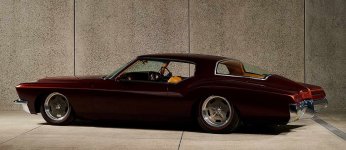
F'n gorgeous. Like a tall woman with some junk in the trunk. Don't you just wanna ride her? You'd win drifting events just by showing up.
Over the years, I've developed a saying - "Turbos are for putting up numbers, but blowers win races." For example, in the years I've been affiliated with PINKS: All Out (and we're bringing it back - we just had our first return even in Gulfport, MS a couple of weekends ago), I've never seen a turbo car win. Nitrous, yes. Blower, yes. N/A, yes. But turbo, no. There may have been one that did, but never in my time with the show (I honestly don't know).
That said, hp is just a number. Particularly in something where having the most hp doesn't help you win, like drifting. If you could put that Buick engine, stock, in whatever car you're using you could drift forever, easily, and have no maintenance issues. I'd be targeting torque as efficiently as possible. As you've discovered, turbos are great for making a number, but are finicky as hell. Here's a couple of my friends lined up against each other two years ago:
That's at one of our All Out Live events before we bought the PINKS brand from FOX this year. As awesome as Bill and Tom's cars are, they both suffer from the turbo conundrum - "I make over 3,000 hp, but I can rarely make a clean pass." There's always some bullshittery, usually related to spooling issues (though in that race, Bill was dialing in a new clutch - yes, that Mustang's a stick car; but the clutch tuning is directly related to - you guessed it - turbo spooling). Tom had spooling issues in the next race (at the end of the video, iirc).
Why am I saying all this seemingly unrelated stuff? Because in my mind, it is related. You'd have more success with a Whipple or (even better) a TVS blower in drifting world than you would a turbo. But you'd need to let go of the "900 hp" idea. I've been around the block enough to know that little K24 will give you fits at that power level, and you don't need hp; you need torque. A TVS or Whipple blower is reasonably efficient and provides boost (and therefore torque) instantly on demand.
NOW - christ, this is long. But I'm on a roll. Was it over when the Germans bombed Pearl Harbor? (points to you if you're old enough to get that reference - otherwise google it)... Anyway, let's bring this back around to... wait for it... ELECTRIFIED BOOST! It's literally the best of all worlds, in fact better from a performance perspective than any of them. More efficient than a turbo, boost that is computer controlled (i.e. faster than humanly possible), on demand, at any rpm with actually variable spool time. You get a bigger tuning window, need less boost to accomplish your goals, etc. The downside - nobody makes anything like this (well, except for me, and mine's not for sale). That's why we're all here, no? I'd love to help people develop their own systems for their own needs - which are different than my own. I'm interested in going fast in a straight line. You aren't. But an electric forced induction system is, on paper anyway, the best for both worlds.

